
Discover essential criteria for B2B buyers: How to choose embroidery fabric supplier. Learn to evaluate factory capability, quality inspection standards, material sustainability, and digital customization for stable global sourcing. Partner with reliability.
Understanding Embroidery Fabric
Embroidery fabric refers to textiles enhanced with stitched patterns, combining aesthetic design with structural durability.
Modern embroidery fabric is widely used across fashion, bridal wear,
upholstery, and luxury accessories. For B2B buyers, selecting the right supplier is critical to ensuring consistent quality,
scalability, and competitive pricing.
In today’s competitive U.S. and global textile market, sourcing from a reliable
embroidery fabric supplier
means more than just product availability—it involves innovation capability, customization flexibility, and strict quality control systems.
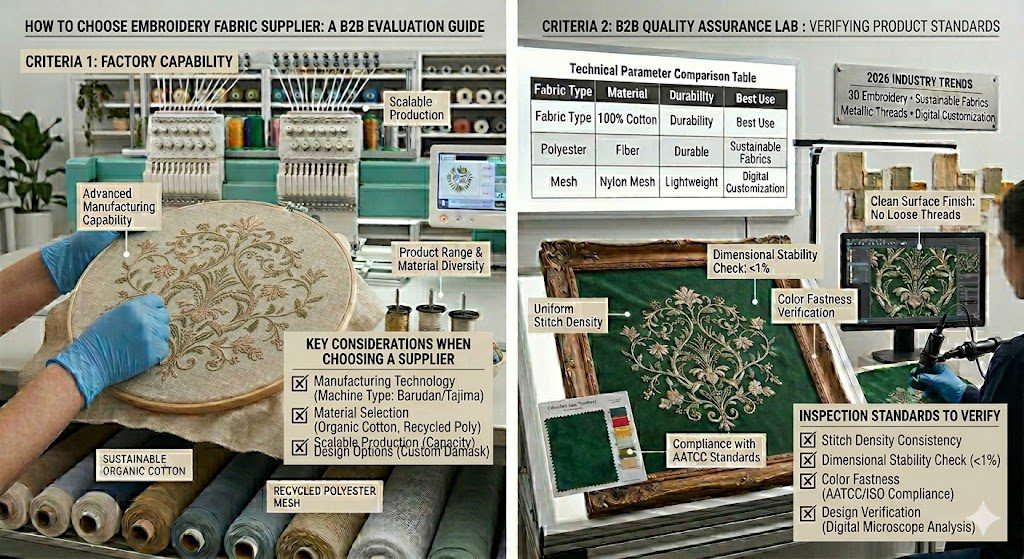
Key Criteria for Choosing an Embroidery Fabric Supplier
- Manufacturing Capability: Partner with an experienced
embroidery fabric manufacturer
that offers advanced machinery and large-scale production. - Product Range: Ensure availability of diverse materials such as cotton, polyester, mesh, and lace-based fabrics.
- Customization Support: Ability to develop unique patterns, colors, and textures tailored to your brand.
- Sampling Services: Access to Free Embroidery Fabric Samples is essential for evaluating quality before bulk orders.
- Lead Time & Logistics: Reliable delivery timelines and global shipping support are crucial.
- Pricing & MOQ Flexibility: Competitive rates for
wholesale embroidery fabrics
without compromising quality.
Technical Parameter Comparison
| Fabric Type | Material | Durability | Best Use |
|---|---|---|---|
| Cotton Embroidery | Natural Fiber | Medium | Casual wear |
| Polyester Embroidery | Synthetic Fiber | High | Mass production |
| Mesh Embroidery | Nylon | Medium | Bridal & fashion |
B2B Quality Inspection Standards
- Stitch Density: Uniform embroidery density across batches
- Color Fastness: Compliance with AATCC or ISO standards
- Dimensional Stability: Shrinkage below 3% after washing
- Surface Cleanliness: No loose threads or defects
- Consistency: Batch-to-batch color and pattern alignment
Evaluating Free Embroidery Fabric Samples allows buyers to verify these criteria before committing to bulk production,
reducing risk and ensuring product consistency.
2026 Embroidery Fabric Trends
- 3D Embroidery: Adds depth and luxury appeal to garments
- Sustainable Fabrics: Growing use of recycled and organic fibers
- Metallic Threads: Rising demand in premium and eveningwear markets
- Digital Customization: Faster prototyping and mass customization capabilities
Forward-thinking suppliers integrate these innovations, making them ideal partners for brands seeking differentiation.
Care & Maintenance Recommendations
- Use cold water washing to maintain embroidery integrity
- Avoid high heat drying to prevent shrinkage
- Store in dry conditions to prevent mold or damage
- Handle gently to avoid distortion of stitched patterns
FAQ for B2B Buyers
Q1: Why are free samples important when choosing a supplier?
Free samples help verify quality, texture, and performance before placing large orders.
Q2: What should I look for in an embroidery fabric supplier?
Focus on production capacity, quality standards, customization options, and pricing competitiveness.
Q3: How long does bulk production usually take?
Standard lead time ranges from 2–4 weeks, depending on complexity and order size.
Q4: Can suppliers handle custom designs?
Yes, most professional suppliers offer full customization services from design to production.
Partner with a Trusted Embroidery Fabric Manufacturer
Yituo Lace provides factory-direct pricing, premium embroidery fabrics, and full customization services for global B2B clients.
From sampling to bulk production, we ensure consistent quality and fast delivery.