Custom Ethnic & Middle Eastern Lace Manufacturer | Fast Sampling
Unlocking Cultural Elegance: Premium Custom Ethnic Lace & Middle Eastern Trims from a Direct Manufacturer…


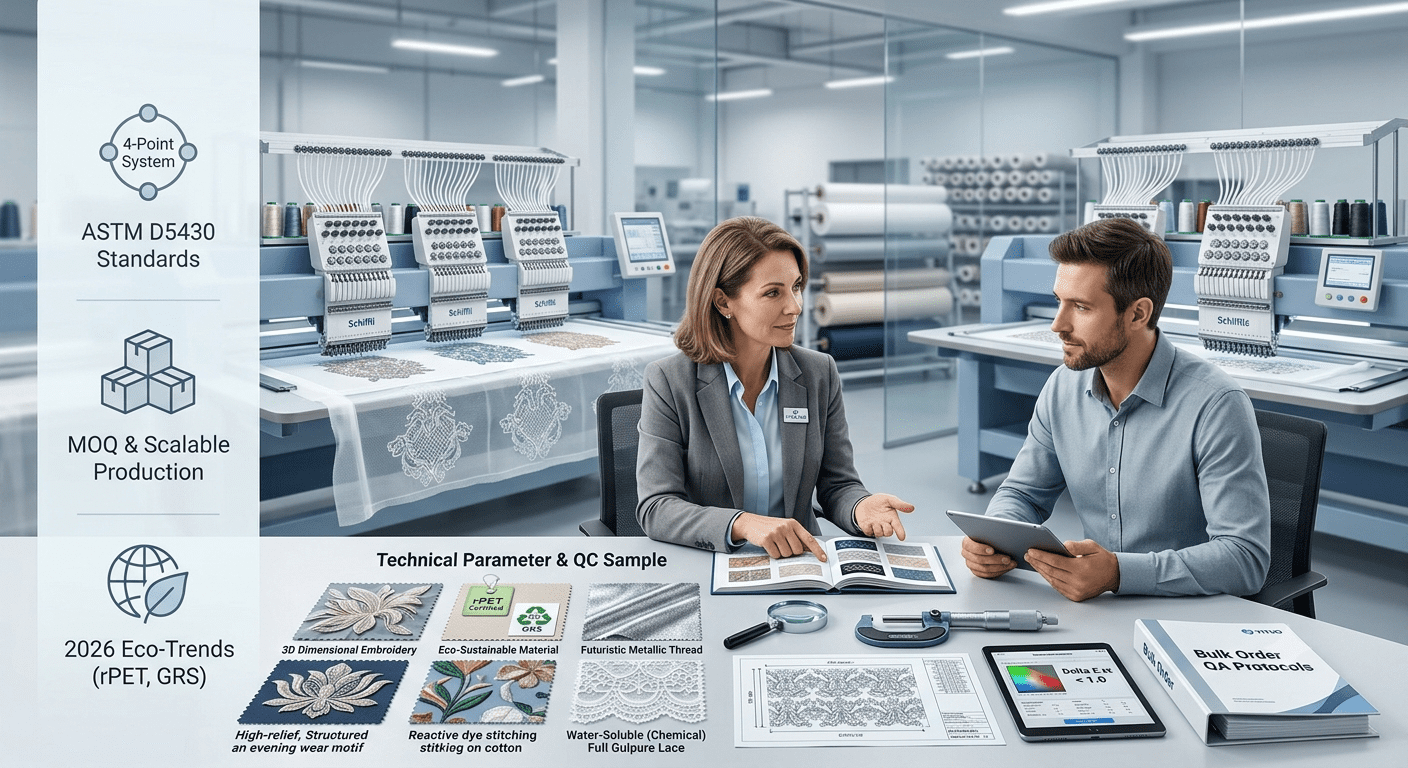
In the modern textile supply chain, initiating a bulk order with a professional embroidery fabric supplier involves more than merely submitting a purchase order. It represents a sophisticated B2B collaboration requiring deep technical alignment, engineering verification, and manufacturing compliance. Bulk ordering is defined as the scaled commercial procurement of high-density embellished textiles, typically starting from a Minimum Order Quantity (MOQ) of 1,000 meters per design pattern.
For fashion brands, home textile enterprises, and large-scale apparel manufacturers, procurement managers must evaluate a supplier’s capacity to deliver stable stitch tension, consistent color fastness, and pattern repeat precision across thousands of yards. Partnering with an established embroidery fabric manufacturer ensures that the initial aesthetic concept transitions smoothly into raw mass production without compromising physical structural integrity. Ultimately, mastering the bulk sourcing workflow is the key to securing reliable margins and mitigating production-line downtime.
When finalizing your procurement specifications for embroidery fabric, selecting the appropriate base ground and thread composition is critical. The structural performance determines the final product’s market positioning. Below is a comprehensive engineering comparison table designed to assist sourcing managers in selecting the ideal technical foundation for their custom embroidery fabric requirements.
| Fabric Parameter Base | Mesh / Organza Base | Cotton / Linen Base | Water-Soluble (Chemical) |
|---|---|---|---|
| Stitch Density Threshold | Low to Medium (Max 8,000/sqm) | High (Up to 25,000/sqm) | Ultra-High (Full Guipure Interlock) |
| Tensile Strength (ISO 13934) | ≥ 350 N (Requires Stabilizer) | ≥ 550 N (Excellent Stability) | ≥ 400 N (Post-wash Interloop) |
| Color Fastness (ISO 105-B02) | Grade 4.0 (Polyester Yarn) | Grade 3.5 – 4.0 (Reactive Dye) | Grade 4.5 (High-Temp Treatment) |
| Shrinkage Rate (Max %) | ≤ 1.5% | ≤ 3.0% | ≤ 2.0% (After Boiling) |
Executing bulk procurement without strict standard operating protocols for quality assurance introduces significant fiscal risks. Experienced B2B QA inspectors deploy the 4-Point System (ASTM D5430) to evaluate raw production runs. When ordering wholesale embroidery fabrics, our industrial inspection protocol dictates that no individual roll should exceed an accumulation of 10 penalty points per 100 square meters.
The primary failure modes monitored by professional auditors during an on-site pre-shipment inspection include:
Maintaining the structural integrity and aesthetic value of bulk embroidery stocks during storage and post-processing is paramount for garment manufacturers. Intricate stitching patterns alter the physical profile of the base textile, introducing variable tension zones that are susceptible to friction and moisture distortion.
Industrial Processing Notice:
Always maintain warehouse conditions at 22°C (±3°C) with a relative humidity level of 45-55% to prevent degradation of specialty backing papers and stabilizer fibers embedded within custom embroidery fabric lots.
When integrating bulk fabric into subsequent manufacturing lines, ensure your cutting room enforces an inversion policy: lay patterned surfaces face-to-face with a tissue interlayer to completely eliminate snagging risks. For washing protocols, industrial sampling must default to laundering inside out inside protective fine mesh bags using non-ionic surfactants, ensuring thermal wash values do not exceed 30°C, followed by non-tension flat drying.
Staying ahead of market curves ensures that your bulk designs resonate with changing consumer appetites. In 2026, the global textile landscape is witnessing a convergence of high-tech manufacturing capability and strict environmental mandates. Buyers looking to develop a custom embroidery fabric collection should emphasize three dominant industry developments:
A professional factory utilizes computerized spectrophotometers (such as Datacolor systems) to secure an objective digital reading. Our manufacturing tolerance standards dictate a Delta E value of ≤ 1.0 against the approved master sample under controlled D65 standard light boxes.
Typically, CAD pattern programming and physical strike-off sampling take 5 to 7 business days. Upon receiving formal client sample confirmation and deposit validation, the physical mass weaving and stitch execution phases require 20 to 30 calendar days, contingent upon structural stitch density and pattern complexity.
Yes, our advanced high-speed Schiffli and electronic multi-head setups handle effective embroidery field widths ranging from 130cm up to 145cm. This accommodates full edge-to-edge pattern coverage for expansive cutting schematics.